Product Launch
Introducing Sonata: see supplier disruptions on day one, not in week three
Key takeaways
- Supplier disruptions start suddenly, but their impact travels slowly. A fire two tiers down your supply chain can take weeks to reach your line.
- The risk grows the further you get from Tier 1: BCG puts disruption risk about 21% higher at Tier 2 and about 38% higher at Tier 3.
- In our conversations with more than 120 companies, the events teams missed were rarely the headlines. They were small, local and specific to one supplier.
- Sonata, which we’re launching today, is built to catch those events early and show which of your parts they affect.
Today we’re launching Sonata, our supplier risk management platform. We built it in Munich, in the TUM ecosystem, for procurement and supply chain teams who can’t keep an eye on every supplier by hand.
Sonata’s AI agents screen your critical suppliers every day, link world events to their sites, routes and parts, and show the source behind every finding. The short film below explains why that matters better than a paragraph could.
One fire, two endings
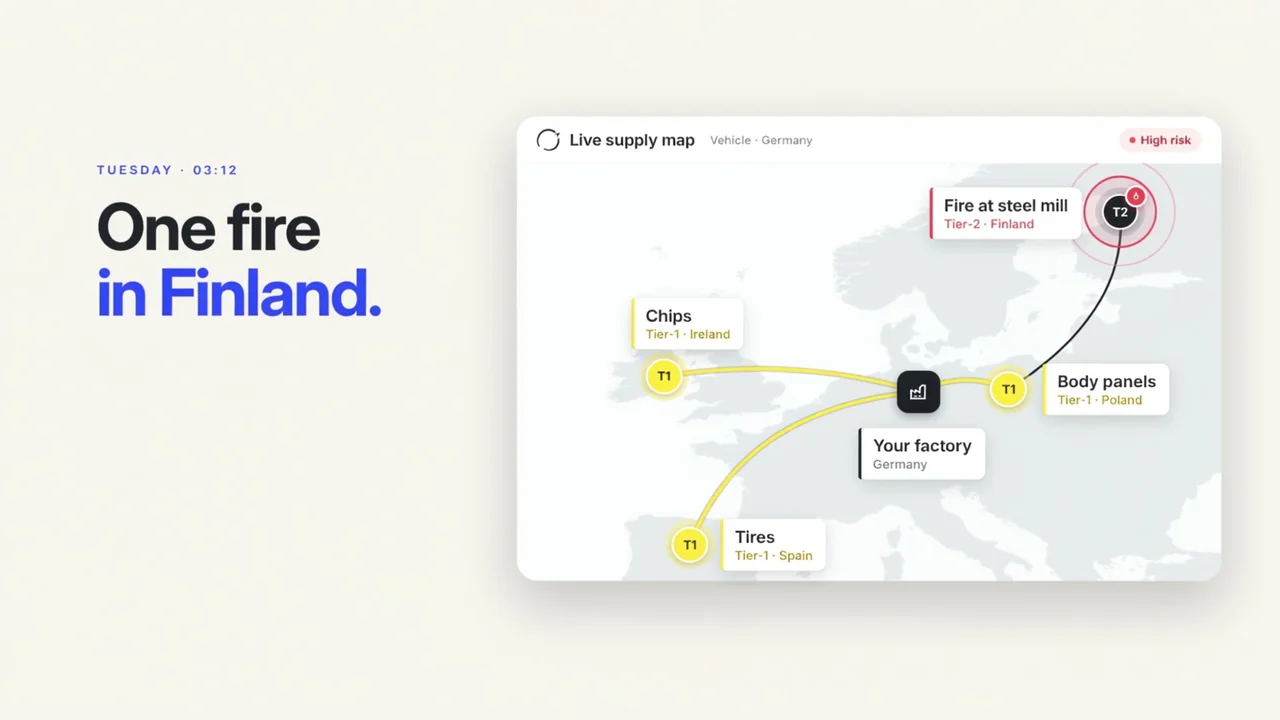
Our film tells the same story twice. A fire breaks out at a steel mill in Finland. You’ve never bought anything from that mill, but it supplies the company in Poland that makes your body panels.
In the first version, nobody connects the fire to your plant. Three weeks later the panels don’t arrive, and your line stops.
In the second version, the fire shows up on day one, already linked to the part it affects. That gives your team three weeks to call the supplier, check stock and line up a second source.
Same fire, same supply chain. The only thing that changes is when you find out.
Sudden events, slow impact
MIT’s Yossi Sheffi has a useful name for this window. He calls it the detection lead time: the time between learning that a disruptive event will hit you and the moment it actually does, which is the warning you get to prepare.
A fire doesn’t come with a warning, of course. But when it happens two tiers away, its effect can take weeks to work its way up to your plant, and those weeks become your detection lead time, as long as you see the fire on day one.
That difference matters a lot in practice. On day one you still have options, while by week three you’re mostly left with emergency buying, express freight and lost output.
Why disruptions are found late
One procurement lead told us how he found out the hard way. His supplier of 30 years called one evening to say they couldn’t deliver the next day.
Stories like that are more common than you’d think, and the reason is fairly simple. Most companies know their direct suppliers well, because they qualify them at onboarding, audit them and review them regularly. The suppliers behind those suppliers, however, rarely show up in any system.
That’s exactly where the risk builds up. According to BCG, disruption risk is about 21% higher at Tier 2 than at Tier 1, and about 38% higher at Tier 3.
| Tier | Who it is | In the film | Typical visibility |
|---|---|---|---|
| Tier 1 | Your direct supplier | Body panel maker in Poland | High: contracts, audits, delivery data |
| Tier 2 | Your supplier’s supplier | Steel mill in Finland | Low: rarely in your systems |
| Tier 3+ | Raw material and sub-component producers | Not shown: ore, alloys, chemicals | Very low: usually unknown |
A dependency you haven’t mapped isn’t low risk. It’s unknown risk.
What we heard from more than 120 companies
Over the past months, we sat down with procurement and supply chain teams at more than 120 companies, and a few themes came up in almost every conversation.
The first was that suppliers get checked once. Onboarding is thorough, with documents, certificates, sanctions screening and credit checks. After that, though, keeping an eye on suppliers usually falls to busy buyers and spreadsheets, and certificates can expire without anyone noticing.
We also heard that the big events are rarely the problem. A war or a typhoon reaches every team within hours. What slips through is smaller and more local, like a flood in one industrial zone, a court filing at a small supplier or a fire at a single plant. In fact, factory fires have been the most frequent supply chain disruption for years.
Many teams had tried to close this gap with tools of their own, from keyword trackers across hundreds of websites to weekly reports merged by hand. Most of them ran into the same wall: checking whether an alert was true, and whether it actually mattered, took longer than the alert saved.
And almost everyone said that an alert on its own isn’t enough. Teams wanted to know which of their orders were affected and what to do next, because a supplier’s plant can be running perfectly while your order sits waiting.
What Sonata does
Sonata reads news and public data feeds every day and matches each event to your suppliers’ sites, to the ports and straits their goods pass through, and to the parts they make for you. You only see the events that match, and each one comes with its source, the reason it matched and how certain it is.
For the suppliers behind your Tier 1, we work with your team during the pilot to map the Tier 2 and Tier 3 suppliers behind your critical parts. Once that map exists, a fire at a sub-supplier shows up as a risk to a specific part and plant rather than as one more headline.
Sonata also runs a health check on each supplier, bringing together sanctions and export-control lists, company registers and news. It tracks commodity prices and shows which of your products depend on them. And if you’d rather just ask, OnyBot, the built-in assistant, answers questions like “What should I worry about this week?” from your own supplier data.
AI prepares the evidence, your team makes the call
Switching a supplier or building safety stock isn’t a data task. It involves quality, contracts and relationships that took years to build, which is why Sonata brings the event, the affected parts and the evidence together and then leaves the decision with your team.
It also helps you decide where to spend. Extra stock and backup suppliers cost money too, so knowing where you’re actually exposed tells you where that money is well spent.
Nobody can predict every crisis, or how long it will last. In our experience, the strongest teams aren’t the ones with the most data; they’re the ones that take the right step, fast.
How to detect supplier disruption early: 5 steps
- List your critical parts. Start with the parts that would stop your line, rather than trying to cover every supplier at once.
- Map them beyond Tier 1. Find the Tier 2 and Tier 3 suppliers and sites behind each critical part. If you can’t name them, you’ve found your first hidden risk.
- Watch events every day. Follow news, public notices and price data for those suppliers, sites and routes, and don’t skip local sources.
- Rank by exposure. Agree which suppliers and parts your team should look at first.
- Decide the next step in advance. Settle who acts on an alert and what the backup is before the alert ever comes.
See Sonata on your own suppliers
If you’d like to see how this looks for your company, request a 30-minute demo. We’ll pick one of your critical parts together and look at which suppliers it depends on, where your exposure sits and what an early warning would look like for your team.